Jurisdiction type: City-state, sovereign republic
Legal system: English common law
Currency: Singapore Dollar (SGD)
Working language: English
Headline corporate tax rate: 17%
Top personal income tax rate: 24% on chargeable income above S$1M
Capital gains tax: None on capital account
Dividend withholding tax: None (one-tier system)
Treaty network: 90+ comprehensive DTAs
Primary Cadena use cases: Personal relocation, treaty holding company, regional HQ, family office (13O/13U)
Singapore is the most credible jurisdiction in Asia for international structuring and personal relocation. It pairs an English common law system, a deep treaty network of more than 90 double tax agreements, and a flat 17% headline corporate tax rate with a residency framework that genuinely supports business owners and families. Cadena uses Singapore as a destination jurisdiction for clients leaving high-tax countries, as a treaty-protected holding company in layered international structures, and as a regional operating base for clients building real presence in Asia-Pacific.
The jurisdiction is fundamentally substance-oriented. The headline tax rate is real, but the tax exemptions, treaty access, and family office incentives all depend on genuine management, decision-making, and local economic activity. Clients who treat Singapore as a nominee-only offshore solution misunderstand the regime; clients who commit to substance find one of the most stable and respected jurisdictions in the world.
For Australian clients in particular, Singapore is a frequent destination after a clean residency break. The Australia-Singapore Double Tax Agreement provides tie-breaker rules, but Cadena's preferred position is ceasing Australian tax residency cleanly on the facts rather than relying on the treaty. Australian-side restructuring is coordinated through our sister firm Cadena Legal.
Founders, family-business principals, and senior executives leaving high-tax jurisdictions for a credible, well-governed Asian base. The typical client meets the bar for one of the upper-tier work passes (ONE Pass, Tech.Pass) or the Global Investor Programme, and is moving for substantive operational reasons alongside the tax outcome.
A Singapore Private Limited Company holding operating entities across the Asia-Pacific region. Singapore's treaty network and one-tier corporate tax system make it a clean intermediate holding jurisdiction for dividends, interest, and royalties flowing across the region. The foreign-sourced income exemption further reduces friction on flows back to the Singapore parent.
Clients building a real operating presence in Asia-Pacific use Singapore as the regional HQ, with employees, decision-making, and expenditure located in Singapore. This pattern supports both treaty access and credibility with banking and regulatory counterparties, and unlocks the Regional Headquarters and International Headquarters tax incentives administered by the Economic Development Board.
Family principals deploying substantial private capital through a Singapore-based family office under the 13O or 13U fund-management tax exemption. Suited to clients who can meet the AUM thresholds (S$20 million for 13O, S$50 million for 13U), the investment professional requirements, tiered local business spending floors, and the capital deployment requirement that at least 10% of AUM or S$10 million (whichever is lower) be invested in Singapore-based investments.
Singapore Pte Ltd as the intermediate holding leg in a multi-jurisdiction structure, often paired with a UAE free zone for active income, a Cayman or BVI top-co for investment holdings, or a personal residency in a different jurisdiction. The structure pairs Singapore's treaty access with the tax efficiency of the upstream and downstream legs.
Clients setting up collective investment vehicles, family-office fund structures, or segregated portfolio arrangements use the Variable Capital Company (VCC). The single legal entity with sub-funds offers operational efficiency for multi-strategy investment programmes, and pairs with the 13O or 13U exemption where qualifying.
Singapore's personal income tax for tax residents is progressive, ranging from 0% on the first S$20,000 of chargeable income to a top marginal rate of 24% on chargeable income above S$1 million. The full bracket schedule is published by IRAS. Non-residents are taxed at a flat 24% on most income, or 15% on employment income (or resident rates, whichever is higher).
An individual is a Singapore tax resident for a Year of Assessment if they are a Singapore citizen or permanent resident who normally resides in Singapore, or a foreigner who has stayed or worked in Singapore for 183 days or more in the preceding calendar year, or for a continuous period straddling two calendar years where the total stay is at least 183 days. See IRAS guidance on tax residency.
Personal reliefs are available for residents, including earned income relief, course fees, CPF cash top-ups, Supplementary Retirement Scheme contributions, parent and child reliefs, and qualifying donations. Capital gains are not taxed on capital account. There is no inheritance tax, estate duty, gift tax, or wealth tax.
Singapore taxes corporate chargeable income at a flat headline rate of 17%, applicable to both resident and non-resident companies as set out by IRAS. Resident companies access additional benefits including treaty protection, foreign-sourced income exemptions, and Singapore's tax exemption schemes.
A Singapore-incorporated company is tax resident if its control and management is exercised in Singapore, which IRAS interprets as the location where strategic decisions are made by the board of directors. A nominee director and registered office alone do not establish residency for treaty purposes.
The Partial Tax Exemption applies to all companies, exempting 75% of the first S$10,000 of chargeable income and 50% of the next S$190,000. Qualifying new start-up companies are eligible for the Start-Up Tax Exemption for their first three Years of Assessment, exempting 75% of the first S$100,000 and 50% of the next S$100,000 of chargeable income, subject to conditions that exclude investment holding and certain property development entities.
Singapore operates a modified territorial system. Foreign-sourced income received in Singapore by a tax resident company is generally exempt where three conditions are met: the income has been subject to tax in the source jurisdiction, the headline tax rate in the source jurisdiction is at least 15%, and the exemption is beneficial to the Singapore taxpayer. The exemption regime is administered under section 13(8) of the Income Tax Act 1947 and detailed in IRAS guidance on foreign sourced income.
Singapore does not tax capital gains. Gains on disposal of equity investments are further protected by Section 13W of the Income Tax Act 1947, which provides certainty of non-taxation on qualifying ordinary share disposals; the sunset clause was removed in Budget 2025 and the section was expanded to include preference shares and group-basis assessment.
Singapore operates a one-tier corporate tax system: dividends paid by a Singapore resident company to its shareholders are tax-exempt in the hands of the recipient, with no further taxation regardless of whether the recipient is local or foreign. There is no dividend withholding tax. Interest paid to non-residents is generally subject to 15% withholding tax, and royalties to 10%, often reduced under applicable treaties.
GST is the Singapore consumption tax, currently 9% (raised from 8% on 1 January 2024). Businesses with annual taxable turnover exceeding S$1 million must register for GST. International services and exports may qualify for zero-rating. See IRAS GST guidance.
Singapore has more than 90 comprehensive Double Tax Agreements (DTAs) in force, including with Australia, the UK, the US (limited tax information exchange only), and most EU member states. The full list is published by IRAS. Treaty benefits require both Singapore tax residency and economic substance; treaty access is increasingly contested by counterpart jurisdictions where substance is absent.
Singapore is a participating jurisdiction in the OECD Common Reporting Standard (CRS) and has implemented FATCA reporting obligations with the United States. Singapore implemented the Pillar Two Global Anti-Base Erosion (GloBE) rules from 1 January 2025, imposing a 15% minimum effective tax rate on Singapore entities of multinational enterprises with consolidated annual revenue above EUR 750 million.
Beneficial ownership information must be maintained under the ACRA Register of Registrable Controllers, though the register is not publicly accessible.
Individual tax residency is determined under the criteria set out by IRAS: 183 days or more of stay or work in Singapore in a calendar year, or a continuous period straddling two calendar years with a total stay of at least 183 days. Citizens and permanent residents who normally reside in Singapore are tax residents by default.
The 183-day test is mechanical. For HNW principals moving from a residence-based system like Australia or the UK, the inbound test is straightforward; the harder side is the outbound clean break from the source jurisdiction. Cadena's preferred sequencing for Australian clients is ceasing Australian tax residency on the facts before establishing Singapore residency, rather than relying on the Australia-Singapore DTA tie-breaker.
The standard work pass for foreign professionals, managers, executives and specialists. Requires a job offer from a Singapore employer and a qualifying minimum salary, currently S$5,600 per month for most sectors and S$6,200 for financial services, with higher thresholds applying to older candidates under the Complementarity Assessment Framework (COMPASS). Full criteria at the Ministry of Manpower. Validity is typically two years initially, renewable. A pathway to Permanent Residency exists but is discretionary and competitive.
Designed for top-tier talent across sectors. Requires a fixed monthly salary of at least S$30,000 in the last year, or comparable achievements in arts, sports, science, or academia. Five-year validity, allows the holder to start and operate multiple businesses concurrently, and is the most flexible work pass for senior individuals. See MOM ONE Pass.
For established technology founders, leaders, and experts. Eligibility requires meeting two of three benchmarks: past compensation of at least S$22,500 per month, at least five years of leading product or R&D at a tech company with valuation or capitalisation over US$500 million or funding over US$30 million, or at least five years of experience in a product or technology with revenue or daily active user metrics in the same scale. Two-year pass, renewable for three more years. See MOM Tech.Pass.
For foreign entrepreneurs starting venture-backable businesses in Singapore. Suitable for early-stage founders with substantial funding from recognised investors, registered intellectual property, accelerator participation, or recognised industry expertise. Initial one-year pass, renewable based on business performance milestones. See MOM EntrePass.
For substantial business owners, family office principals, and founders committing significant capital to Singapore. Provides direct Permanent Residency rather than a work pass. The base track (Option A) requires a business investment of S$10 million in a new or existing Singapore business operation. Option B requires S$25 million invested in an approved Singapore-based fund. Option C is the Single Family Office track, requiring S$200 million in assets under management with at least S$50 million deployed in qualifying Singapore investments, alongside hiring local employees. The bar is high and selection is discretionary. Administered by the Economic Development Board.
EP and S Pass holders can apply for Permanent Residency through the Professionals, Technical Personnel and Skilled Workers (PTS) scheme administered by the Immigration and Checkpoints Authority. Approval is discretionary and typically requires demonstrated economic contribution, salary level, length of employment, and family circumstances. PR is not guaranteed and may take multiple application cycles.
Singapore citizenship requires PR status for at least two years before application, alongside other criteria including good character and economic contribution. Singapore does not generally permit dual citizenship; naturalisation typically requires renunciation of prior citizenship.
Most main pass holders can apply for Dependant Passes for legally married spouses and unmarried children under 21, and Long-Term Visit Passes for parents and common-law partners, subject to salary thresholds set by MOM. Children of pass holders generally have access to international and private schools; admission capacity is the practical constraint.
The standard Singapore operating or holding company. Limited liability, separate legal personality, at least one director who is ordinarily resident in Singapore, at least one shareholder, no minimum paid-up capital. Incorporation is handled by ACRA and typically completes within one to three business days. The Pte Ltd is the workhorse for both operating businesses and holding-company structures and qualifies for the full range of Singapore tax exemptions and treaty access.
Singapore's dedicated investment fund vehicle, introduced in 2020. Allows segregated sub-funds within a single legal entity, with assets and liabilities of each sub-fund ring-fenced from the others. Used for collective investment schemes, family-office fund structures, and multi-strategy investment programmes. Must be managed by a Singapore-licensed or exempt fund manager. The VCC pairs naturally with the 13O or 13U family office exemption where qualifying. See the MAS VCC framework.
Used in specific professional services and fund contexts. The LP is tax-transparent and is commonly used in venture capital and private equity fund structures. The LLP combines limited liability with pass-through taxation for the partners. Generally not the right vehicle for international corporate structuring; Cadena defaults to Pte Ltd unless there is a specific reason to use a partnership.
A foreign company may register a Singapore branch, which is treated as a non-resident company taxed at 17% on Singapore-source income. Branches do not generally qualify for tax exemptions available to resident companies and do not access treaty benefits in the same way. A Representative Office is a non-trading liaison presence used for market research and feasibility; it cannot generate revenue.
Singapore trust law is based on English common law principles, governed by the Trustees Act 1967. Singapore has a sophisticated private trust company (PTC) framework, used by HNW families for governance of family wealth. Singapore does not have a dedicated foundation regime, so foundations are typically established offshore (Liechtenstein, Panama, Jersey, Cayman) and may hold Singapore-resident underlying structures.
Singapore administers a wide range of tax incentive schemes including the Global Trader Programme, Financial Sector Incentive, Maritime Sector Incentive, Pioneer Certificate Incentive, Development and Expansion Incentive, and the Regional and International Headquarters incentives administered by EDB. Each requires application, qualifying activity, and economic substance commitments. See the EDB incentives catalogue.
The most-used wealth-structuring vehicle for HNW families in Singapore. The Single Family Office (SFO) acts as the fund manager for a Singapore-resident fund vehicle that qualifies for tax exemption under section 13O (Onshore Fund Tax Exemption) or section 13U (Enhanced-Tier Fund Tax Exemption) of the Income Tax Act 1947.
Section 13O: Singapore tax resident fund vehicle, minimum S$20 million AUM at application, at least two investment professionals (one of whom can have a 12-month grace period), tiered local business spending starting at S$200,000 per year, and the capital deployment requirement of 10% of AUM or S$10 million (whichever is lower) in Singapore-based investments.
Section 13U: More flexible vehicle (Singapore or offshore, company or LP or trust or VCC), minimum S$50 million AUM at application, at least three investment professionals (one non-family member), tiered local business spending (higher than 13O), and the same 10% / S$10 million capital deployment requirement.
Both schemes were significantly refreshed effective 1 January 2025. AUM is now measured against Designated Investments rather than total NAV, and the local business spending requirement is tiered by fund size. See MAS Fund Tax Schemes for Family Offices for current application guidelines.
Singapore is most commonly used as a treaty-protected intermediate holding company over operating entities in Asia, as a regional headquarters for clients building real operating presence in Asia-Pacific, or as the personal residency leg paired with corporate structures elsewhere (UAE free zone for active income, Cayman or BVI top-co for investment holdings). For Australian clients restructuring out of Australia, the Singapore Pte Ltd serves as a clean, treaty-eligible intermediate holding company that pairs with the personal residency move.
Singapore is one of the most sophisticated private and corporate banking centres in the world, regulated by the Monetary Authority of Singapore. The three domestic systemically important banks are DBS, OCBC, and UOB. International private banks with significant Singapore operations include UBS, Citi Private Bank, J.P. Morgan Private Bank, HSBC Private Banking, Standard Chartered, Bank of Singapore, and LGT.
Singapore banking is sophisticated but increasingly KYC-heavy. Domestic banks (DBS, OCBC, UOB) will open accounts for bona fide structures but require source-of-funds documentation, substance evidence, and usually a Singapore-resident director presence at account opening. International private banks operate to their own AUM thresholds, generally starting from US$1 million to US$5 million depending on the bank and product set.
For Cadena's international structuring clients, an EP or PR holder with a real Singapore operating entity and demonstrated source of funds will open corporate and personal accounts within a reasonable timeframe. Pure offshore holding structures without Singapore substance face significantly tighter scrutiny and longer onboarding.
Singapore banks tightened materially after the 2023 anti-money laundering enforcement actions that resulted in over S$3 billion in seized assets and several high-profile prosecutions. Source of funds documentation must be specific and traceable; "investment income from family wealth" is not sufficient. Where Singapore is being used as the principal banking jurisdiction, expect formal questioning on every material funds movement.
Singapore has a developed EMI ecosystem including Wise (Wise Asia-Pacific is MAS-licensed), Aspire, Currenxie, Airwallex, and various fintech players. EMIs are appropriate for early-stage businesses, transactional flows, and FX management, but are not a substitute for a full banking relationship when substantial flows, lending, or wealth management services are needed.
Singapore is a major foreign exchange centre. Multi-currency accounts are standard at both domestic and international banks. SGD is freely convertible. Cross-border payments operate efficiently through SWIFT, with same-day or next-day settlement to most major counterparties.
SFOs operating under 13O or 13U typically maintain banking relationships with one or two private banks alongside a custodian relationship (often DBS Private Banking, Bank of Singapore, or one of the international private banks). The relationship is structured around the fund vehicle rather than the SFO itself, with the SFO acting as discretionary manager.
Government services, including Singpass digital identity, are world-class and fully English-language. International schools have waiting lists; planning ahead is essential for families with children. Healthcare via private providers is excellent. Residential rental and property markets are at the high end of the global spectrum. The Land Transport Authority's Certificate of Entitlement (COE) system for vehicle ownership adds tens of thousands of SGD to the cost of running a car.
Visa and work pass application fees are modest in absolute terms, typically S$105 to S$225 per application depending on the pass type, plus issuance fees. The Global Investor Programme requires a substantial capital commitment rather than a fee: S$10 million in business investment (Option A), S$25 million in an approved fund (Option B), or S$200 million AUM with substantial local deployment (Option C).
Ongoing cost of living in Singapore sits at the high end of the global spectrum. A reasonable family budget for a senior executive household runs in the S$200,000 to S$500,000 range per year, driven primarily by residential rent (S$8,000 to S$25,000 per month for premium apartments and landed properties), international school fees (S$30,000 to S$50,000 per child per year), and motor vehicle ownership (COE alone adds S$80,000 to S$120,000 to a typical car purchase).
All-in first-year incorporation cost, including company secretary, registered office, nominee director (where required), and corporate secretarial setup, typically falls in the range of S$3,000 to S$8,000 depending on the service provider and structure complexity. ACRA government fees are minor (S$315 for incorporation).
Ongoing annual maintenance typically runs S$2,500 to S$6,000 for company secretarial, registered office, and statutory compliance services, plus accounting and tax compliance which scales with transaction volume. Audit is mandatory unless the company qualifies for small company exemption (two of three criteria: revenue under S$10 million, assets under S$10 million, fewer than 50 employees).
Setup and ongoing costs for a compliant Singapore SFO are substantially higher than a standard Pte Ltd. Expect first-year setup costs in the range of S$200,000 to S$500,000, plus the mandatory local business spending of S$200,000 (13O entry tier) to S$1 million (13U upper tier) per year, plus investment professional salaries (each IP must earn at least S$3,500 fixed monthly and be tax resident in Singapore), plus the AUM commitment itself. Ongoing administration, fund accounting, audit, and MAS reporting add a further S$150,000 to S$400,000 per year.
Corporate bank account opening fees are generally minor at domestic banks. International private banks may charge onboarding fees for complex structures and typically require minimum deposit or AUM commitments. Statutory audit for a Singapore company that does not qualify for the small company exemption typically costs S$5,000 to S$25,000 depending on complexity.
There is no minimum capital requirement to incorporate a Pte Ltd; S$1 paid-up capital is acceptable. Stamp duty applies to share transfers (0.2% of consideration or net asset value, whichever higher). GST registration is mandatory for businesses with turnover above S$1 million; voluntary registration is available below that threshold.
Cadena fees for the structuring decision and implementation are scoped per engagement. A typical Singapore relocation engagement covers jurisdiction analysis, pass selection and application coordination, Pte Ltd incorporation, banking introductions, family arrangements (housing, schooling, healthcare), and post-arrival on-the-ground coordination. Australian-side restructuring is coordinated through our sister firm Cadena Legal.
The 17% headline corporate tax rate is real. The Partial Tax Exemption and Start-Up Tax Exemption reduce the effective rate at lower profit levels but do not turn Singapore into a zero-tax jurisdiction. Clients pitched on Singapore as an offshore solution often misunderstand this. Singapore makes sense on the basis of stability, treaty access, banking, and ecosystem; not on the basis of headline rate alone.
IRAS and treaty partners scrutinise nominee-only Singapore structures. Treaty benefits, certificates of residence, and the foreign-sourced income exemption regime all assume genuine management, decision-making, and substance in Singapore. A Singapore Pte Ltd with no employees, no office activity, and no local decisions is increasingly exposed to challenge from counterpart revenue authorities and may have certificate of residence applications denied.
The 13O and 13U fund-management exemptions were refreshed effective 1 January 2025, with stricter AUM measurement (Designated Investments rather than NAV), tiered local business spending requirements, capital deployment requirements for Singapore-based investments, and stricter investment professional qualification. Family office structures planned against pre-2023 thresholds are out of date. Any client considering Singapore for a family office should plan against the current rules, not historical assumptions.
Moving to Singapore without breaking Australian tax residency cleanly produces dual residency and Australian tax exposure that the move was supposed to solve. The Australia-Singapore DTA has tie-breaker rules, but relying on them is structurally weaker than ceasing Australian residency on the facts. Australian CGT consequences on departure, including the deemed disposal of non-TAP assets under CGT event I1, must be planned for separately. This is coordinated with our sister firm Cadena Legal.
An Employment Pass does not automatically convert into PR. ICA approval is discretionary, sometimes takes multiple application cycles, and there is no published guarantee of approval. Clients planning a multi-generation relocation should not assume PR as a certainty; the planning should work even if PR is not granted in the first or second application cycle.
Residential rents, private and international schooling, and motor vehicle ownership are at global highs. Clients underestimating the operational cost of a Singapore move can find the tax saving materially eroded by the lifestyle cost base. For a senior executive family, the after-tax lifestyle cost in Singapore is often comparable to or higher than the equivalent in Sydney or London despite the lower marginal tax rate.
Singapore implements the OECD Common Reporting Standard, so beneficial ownership and account information of Singapore-resident structures and accounts is reported to the tax authority of the beneficial owner's country of tax residence. The ACRA Register of Registrable Controllers is not publicly accessible but is available to law enforcement. Clients expecting Singapore to provide privacy from their home jurisdiction's tax authority are mistaken.
The 2023 money laundering enforcement actions raised the compliance bar materially. Banks now require specific, traceable, documented source of funds for material movements. "Family wealth" is insufficient. Clients arriving without organised source of funds documentation face account opening delays of months and in some cases account refusals.
The Singapore Budget 2026 was delivered on 18 February 2026. Key measures relevant to international structuring and HNW relocation include a Corporate Income Tax Rebate of 40% of tax payable for YA 2026, capped at S$30,000 total benefit including the CIT Rebate Cash Grant of at least S$1,500 for active companies with local employees. Full details at the IRAS Singapore Budget page.
Budget 2025 delivered substantial reforms including a 50% CIT Rebate capped at S$40,000, the removal of the Section 13W sunset clause for non-taxation of equity disposal gains (expanded to preference shares and group-basis assessment), enhancements to the Foreign-Sourced Income Exemption regime including rental and ancillary income received from 19 February 2025, extension of the Insurance Business Development scheme to 31 December 2030 with a new 15% concessionary tax rate tier, and new tax incentives for new corporate listings and fund manager listings in Singapore. See the IRAS Budget 2025 page.
Singapore implemented the OECD/G20 Pillar Two Global Anti-Base Erosion (GloBE) rules from 1 January 2025, applying a 15% minimum effective tax rate to Singapore entities of multinational enterprise groups with consolidated annual revenue above EUR 750 million. Singapore introduced a Domestic Top-up Tax (DTT) and Multinational Enterprise Top-up Tax (MTT) to capture the top-up where the effective tax rate falls below 15%. Most Cadena clients fall below the EUR 750 million threshold and are unaffected.
MAS refreshed the application guidelines for the 13O, 13U, and 13D fund tax exemption schemes effective 1 January 2025. Key changes: AUM measured against Designated Investments rather than total NAV; tiered Local Business Spending replacing the flat thresholds; capital deployment requirement of 10% of AUM or S$10 million (whichever is lower) in Singapore-based investments; stricter Investment Professional requirements including Singapore tax residency and minimum monthly salary of S$3,500. Current application guidelines on the MAS Fund Tax Schemes for Family Offices page.
The Goods and Services Tax rate increased from 7% to 8% on 1 January 2023, and from 8% to 9% on 1 January 2024. The 9% rate remains current.
The 2023 Singapore anti-money laundering case, which resulted in over S$3 billion in seized assets across ten defendants, was the largest in Singapore's history. The case led to material tightening of bank KYC and source-of-funds documentation requirements across all major Singapore banks. The downstream compliance posture remains elevated.
A foreign individual generally becomes Singapore tax resident in the calendar year they spend 183 days or more in Singapore, or across a continuous period straddling two calendar years where the total stay is at least 183 days. The test is mechanical and does not require an application.
Possibly, but the result is dual tax residency which generally produces tax exposure in both countries until a treaty tie-breaker resolves the conflict. For Australian clients, Cadena's preferred outcome is ceasing Australian tax residency on the facts before establishing Singapore residency, rather than relying on the DTA tie-breaker.
The current minimum is S$5,600 per month for most sectors, S$6,200 for financial services, and higher for older applicants under the COMPASS framework. The Ministry of Manpower also assesses qualifications, employer profile, and complementarity. Current criteria at MOM.
Not necessarily. Most work passes require Singapore employment, which can be with an existing Singapore employer rather than a company you control. However, founders and senior executives often incorporate a Singapore entity as the relocation vehicle and structure their compensation through it. The right approach depends on the client's broader structuring.
No. Singapore is a regulated, OECD-compliant, treaty-network jurisdiction with a 17% corporate tax rate and 24% top personal rate. It is on no major blacklist (EU, OECD) and participates fully in CRS and BEPS frameworks. The advantages are structural (treaty access, common law, banking, talent, ecosystem) rather than rate-based.
You can operate a family office below the 13O AUM threshold of S$20 million, but you cannot qualify for the 13O fund tax exemption. Below that threshold, the family office typically uses a standard Singapore Pte Ltd holding structure without the tax exemption, paying 17% corporate tax on Singapore-source income and accessing the foreign-sourced income exemption where qualifying.
Foreign-source income is taxed in Singapore only when received in Singapore. Where received, it is generally exempt under section 13(8) of the Income Tax Act 1947 if the income has been subject to tax in the source jurisdiction, the source jurisdiction headline rate is at least 15%, and the exemption is beneficial. See IRAS guidance.
Tax residency for a company is determined by where control and management is exercised, which IRAS interprets as where strategic decisions are made by the board of directors. Both resident and non-resident Singapore companies pay 17% corporate tax on Singapore-source income, but only resident companies access tax exemptions, treaty benefits, and the foreign-sourced income exemption.
Yes in principle, but in practice it is materially harder than for residents. Non-resident corporate account opening at the domestic banks requires substance evidence, source of funds documentation, and often a director presence in Singapore. International private banks operate to AUM thresholds rather than residency. EMI alternatives are easier to open but are not a substitute for a full banking relationship.
Singapore does not tax capital gains, so crypto held on capital account is generally tax-free on disposal. Crypto held as trading stock or used in a business is taxed as ordinary income at 17%. GST applies to digital payment tokens used as means of payment (subject to specific exemptions). MAS regulates crypto service providers under the Payment Services Act 2019. See IRAS guidance on digital tokens.
Singapore is one of the most credible jurisdictions in the world for both personal relocation and international structuring, but the right structure depends on the facts of your life. The conversation that treats those facts as inputs, rather than offering Singapore as a generic offshore product, is the conversation we run with every client.
If you are considering Singapore as a destination or as a holding jurisdiction in a layered structure, Cadena International is built for that conversation. We coordinate the full process: jurisdiction analysis, work pass selection, incorporation, banking introductions, family arrangements, and post-arrival support. Australian-side restructuring is coordinated through our sister firm Cadena Legal.
Articles on the Cadena International blog that pair with this jurisdiction page:

May 22, 2026
|
9 min read
How an Australian who owns an international or online business can relocate to the Cayman Islands, a jurisdiction with no income, corporate, capital gains or inheritance tax, through one of its investment or substantial-business-presence residency routes.

May 22, 2026
|
8 min read
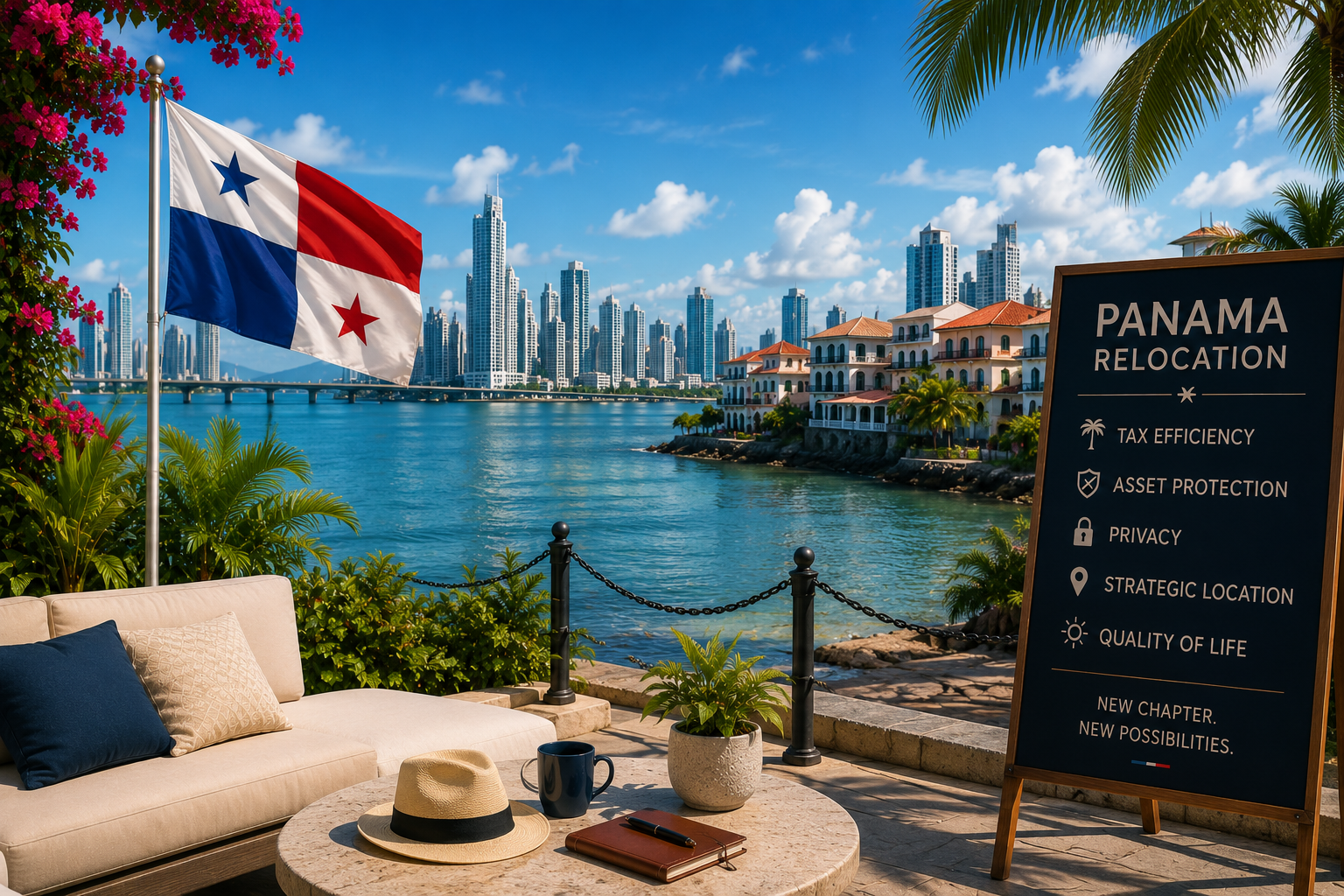
How an Australian who owns an international or online business can relocate to Panama by obtaining residency through the Friendly Nations Visa, and basing themselves in a territorial-tax jurisdiction that does not tax foreign-source income.

May 19, 2026
|
9 min read
How an Australian who owns an international or online business can relocate to Singapore by setting up a company, obtaining an Employment Pass through it, and basing themselves in a low-tax, no-capital-gains-tax jurisdiction.